1951
Ace in the Hole
Drama
8.0
User Score
770 Votes
Status
Released
Language
en
Budget
$1.821.052
Production
Paramount Pictures
Overview
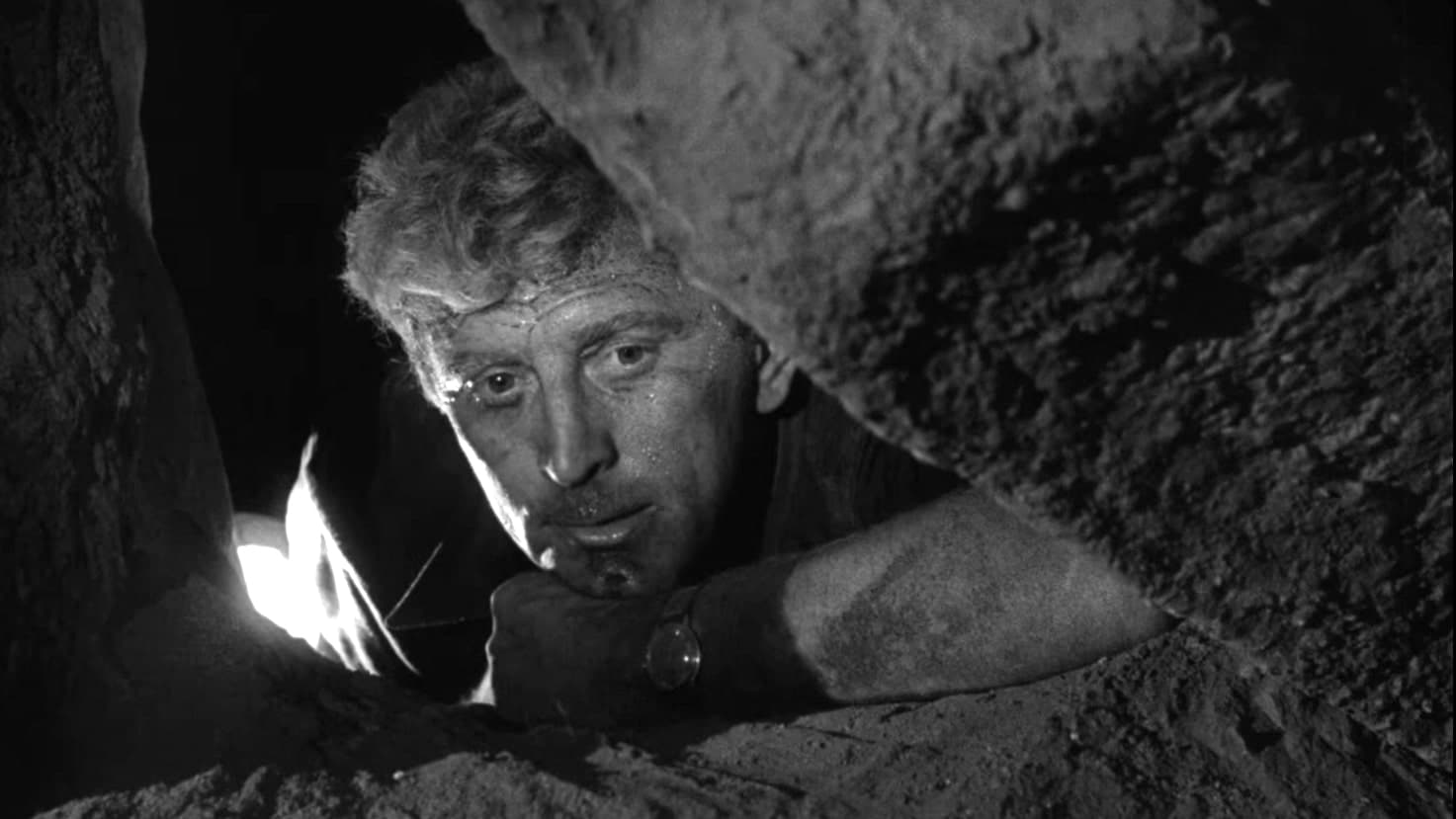
An arrogant reporter exploits a story about a man trapped in a cave to revitalize his career.
Review

John Chard
9.0
It's a good story today. Tomorrow, they'll wrap a fish in it.
Ace in the Hole is directed by Billy Wilder and Wilder co-writes the screenplay with Lesser Samuels, Walter Newman and Victor Desny. It stars Kirk Douglas, Jan Sterling, Bob Arthur, Porter Hall and Richard Benedict. Music is by Hugo Friedhofer and cinematography by Charles Lang Jr.
Chuck Tatum (Douglas) is a one time big-city journalist who is now stuck working for an out of the way Albuquerque newspaper. When on his way to another mundane reporting job he happens upon the chance to exploit a story about a man trapped in a cave to rekindle his career and put him back in the big league. However, the situation quickly escalates into an out-of-control media circus...
Inspired by the real life Floyd Collins disaster in 1925, Ace in the Hole finds Wilder on supreme acerbic and cynical form. Flopping upon release, nobody was quite ready for Wilder to paint an uncompromising portrait of the human spirit stinking to high heaven. It now holds up as one of the finest exponents of media machinations and the human fallibility that encompasses a thirst for tragedy.
Douglas leads the way with one of his finest and intensified performances, filling Chuck Tatum with a reprehensible attitude to media ladder climbing. When one witnesses the harrowing sequences as Tatum talks to the trapped Leo Minosa (Benedict tugs the heart strings), telling him it's going to be alright, we feel complicit in knowing just exactly what is going on up top. Leo adores his wife Lorraine (Sterling a splendidly subtle bitch perf hiding hollow turmoil), but she has wanted out for some time, but under Chatum's prompting she sticks around to make money on her husbands trapped suffering.
Pretty soon this one store tin-pot town is booming, tills are ringing and the papers are selling big time, the coupling of Tatum and Lorraine is a match made in hell. Dialogue is in true noir fashion often sharp and biting, even with some of Wilder's customary humour deftly tucked away. As the exploitation of the situation reaches fever pitch, and the hypocrisy of the human condition is laid bare, "Ace in the Hole" proves itself to be a pitiless story that is a compelling journey for the viewers invested in the darker shades of what Wilder was fronting. A big flip-flop for a main character's behaviour at film's end seems a little out of place, given what has preceded it, but the ending is straight out of noirville and ensures the pic is a near masterpiece from a true master of his craft. 9/10
Read More badelf
7.0
Billy Wilder's Ace in the Hole remains a masterclass in cynicism, even if the world it depicts has shifted beyond recognition. Kirk Douglas delivers one of his finest performances as Chuck Tatum, a disgraced reporter who transforms a man's entrapment in a collapsed cliff dwelling into a calculated media spectacle. Wilder's direction is sharp, controlled, ruthless; the film moves with the precision of a man tightening a noose. What's aged less gracefully is the premise itself. In an era where AI generates content and the few remaining journalists on the ground lack the luxury of time Tatum exploits so coldly, the mechanics of his manipulation feel like relics from another industry entirely.
Tatum arrives in Albuquerque, fired from eleven newspapers for lying, drinking, and worse. He takes a job at a small-town paper, biding his time until he can claw his way back to the big leagues. When he stumbles upon Leo Minosa, trapped in a cave while hunting for Native American artifacts, Tatum sees his ticket out. He doesn't just report the story; he choreographs it, conspiring with a corrupt sheriff to delay the rescue, ensuring the drama stretches long enough to attract national attention. A carnival springs up around the site, Leo's wife profits from the crowds, and thousands gather to watch. Tatum gets his headlines.
Douglas makes Tatum electric, a man whose charm and intelligence are inseparable from his cruelty. He doesn't play Tatum as a monster; he plays him as a man who believes the world owes him something and is willing to collect by any means necessary. It's a towering performance, one that carries the film even when the viewer's suspension of disbelief begins to fray. The notion that drilling from above wouldn't cause a cave-in, or that 1950s equipment could position itself with such confidence, strains credibility. But these are minor complaints in a film concerned less with engineering logistics than with moral collapse.
What renders Ace in the Hole more artifact than warning is how thoroughly journalism has transformed. Tatum's slow-burn manipulation, his ability to camp out at the site and control the narrative for days, belongs to a media landscape that no longer exists. Today's news cycle doesn't allow for such patience; stories are algorithmically generated, attention spans measured in hours, not weeks. Yellow journalism persists, Fox News and its ilk trade in distortion and spectacle, and quality investigative reporting still exists, but the average person scrolling through their feed makes no distinction between the two. Tatum's brand of hands-on villainy has been replaced by something more diffuse, more automated, harder to identify.
Yet the film endures as a study in systemic unscrupulousness. Tatum is the engine, but he's hardly alone. The sheriff sees political opportunity. Leo's wife sees profit. The public sees entertainment. Everyone colludes, everyone profits, and the man in the cave becomes the least important figure in his own tragedy. Wilder understands that corruption isn't an aberration; it's a collaboration. That insight hasn't aged a day.
Ace in the Hole is worth watching for Douglas's ferocious performance and Wilder's command of craft. Its specific warnings about journalism may feel like dispatches from a distant era, but its broader indictment of opportunism, complicity, and the human appetite for spectacle remains uncomfortably sharp.
Read More